The Parva naturalia in Greek, Arabic and Latin Aristotelianism by Börje Bydén & Filip Radovic
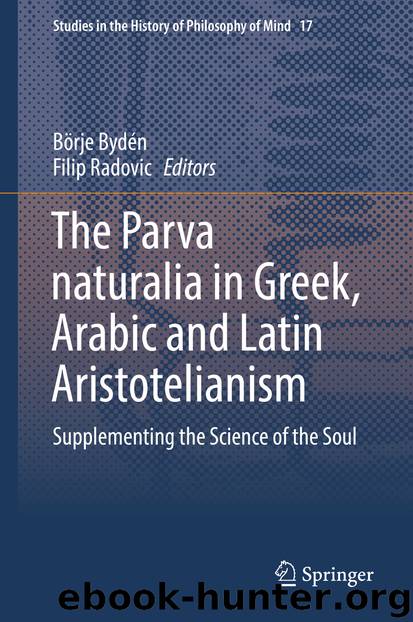
Author:Börje Bydén & Filip Radovic
Language: eng
Format: epub
ISBN: 9783319269047
Publisher: Springer International Publishing
The interpretation of this passage in terms of the efficient cause is probably also suggested to Albert by Aristotle’s terminology; as he remarks earlier in the commentary, the technical term “principium” (arche), which is used in this context, properly indicates the efficient cause.42 It is interesting to compare Albert’s approach in the discussion of the location of the internal senses to that of another early commentator of Aristotle’s De somno et vigilia, the already mentioned English master Geoffrey of Aspall. In his questions on De somno et vigilia, which are possibly slightly later than Albert’s commentary, Geoffrey, like Albert, consents to Averroes’ theory of a twofold principle of sense perception, that is, the heart and the brain, but he also stresses the existence of a disagreement between Aristotle and Averroes. More precisely, he reports three different positions, that of the physicians (medici), who identify the organ of the common sense with the brain, Aristotle’s position, who identifies that organ with the heart, and Averroes’ mediating position, which he prefers.On this point there are three opinions. One is that of the physicians, according to which the proper organ of the common sense is in a straightforward way the brain, whereas the heart is so only incidentally, for the heart does not flow into the particular senses except via the brain. The heart, they say, for all its being the first sensorium and the origin (principium) of sense, yet is not the proximate origin, whereas the brain is the proximate origin of the common sense. Others say—as also Aristotle appears to hold—that the heart is the proper organ of the common sense and by itself, whereas the brain is so only incidentally. According to them, the particular senses do not rely on the brain except incidentally. Since, namely, the spirits that originate directly from the heart are hot, and so would destroy the particular senses if they were directly mixed with or admitted to them, nature has come up with a cold organ, viz. the brain, so that the heat of the spirits may be moderated before they are transmitted further to the particular senses. A third, and truer, opinion, is, as it were, midway between the two first ones, and in better accord with Averroes’ view in his On the Treatise about Memory and Recollection, in which he says that the heart is the first organ of the common sense, but the brain its secondary and proximate organ.43
Download
This site does not store any files on its server. We only index and link to content provided by other sites. Please contact the content providers to delete copyright contents if any and email us, we'll remove relevant links or contents immediately.
Rewire Your Anxious Brain by Catherine M. Pittman(18737)
Talking to Strangers by Malcolm Gladwell(13474)
The Art of Thinking Clearly by Rolf Dobelli(10637)
Mindhunter: Inside the FBI's Elite Serial Crime Unit by John E. Douglas & Mark Olshaker(9450)
Becoming Supernatural by Dr. Joe Dispenza(8303)
Change Your Questions, Change Your Life by Marilee Adams(7875)
Nudge - Improving Decisions about Health, Wealth, and Happiness by Thaler Sunstein(7775)
The Road Less Traveled by M. Scott Peck(7685)
The Lost Art of Listening by Michael P. Nichols(7568)
Mastermind: How to Think Like Sherlock Holmes by Maria Konnikova(7459)
Enlightenment Now: The Case for Reason, Science, Humanism, and Progress by Steven Pinker(7369)
Win Bigly by Scott Adams(7285)
The Way of Zen by Alan W. Watts(6689)
Daring Greatly by Brene Brown(6576)
Big Magic: Creative Living Beyond Fear by Elizabeth Gilbert(5850)
Grit by Angela Duckworth(5686)
Ego Is the Enemy by Ryan Holiday(5563)
The Laws of Human Nature by Robert Greene(5350)
Men In Love by Nancy Friday(5325)
